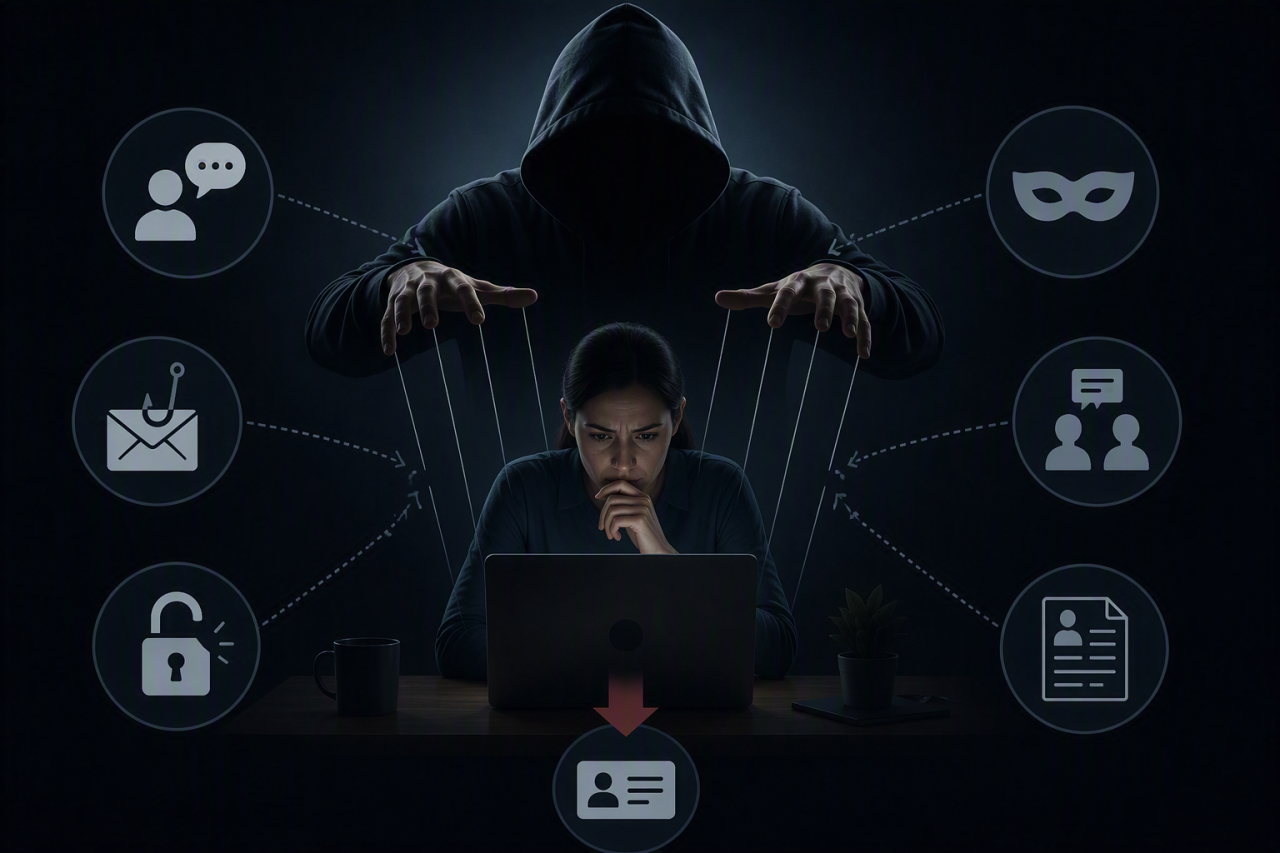
When most people think about cybercrime, they picture hackers breaking through firewalls, writing malicious code or exploiting software vulnerabilities.
In reality, many successful cyber-attacks don’t begin with technology at all.
They begin with a conversation.
Social engineering has become one of the most effective tools in a cybercriminal’s arsenal because it focuses on manipulating people rather than attacking systems. Instead of finding a flaw in your network, an attacker finds a way to persuade someone to provide information, click a link, reset a password or grant access. And unfortunately, it works.
What Is Social Engineering?
Social engineering is the practice of manipulating individuals into performing actions or disclosing information that benefits an attacker.
Rather than exploiting a technical weakness, the attacker exploits human psychology. They may use trust, fear, urgency, authority, curiosity or even helpfulness to convince someone to do something they normally wouldn’t.
The ultimate goal is usually one of the following:
- Steal sensitive information
- Gain access to systems or accounts
- Deploy malware or ransomware
- Commit financial fraud
- Gather intelligence for a larger attack
The reason social engineering is so effective is simple: people are naturally inclined to help others, trust colleagues and respond quickly when something appears urgent.
Why Is Social Engineering So Dangerous?
Most businesses invest heavily in cyber security technology. They have anti-virus software, spam filtering, firewalls, backups and multi-factor authentication.
But cybercriminals know that bypassing technology is often easier than breaking through it.
If they can persuade an employee to reveal information or perform an action on their behalf, many security controls become irrelevant.
That is why social engineering is frequently used as the starting point for larger cyber-attacks, data breaches and ransomware incidents.
A Real-World Example
The recent Department for Education (DfE) cyber incident brought social engineering into the spotlight.
According to reports, attackers gained access to systems through a social engineering attack targeting a helpdesk environment, resulting in the theft of more than 600,000 records containing contact information.
While investigations are ongoing, the incident demonstrates an important point: organisations can have strong technical security controls and still be vulnerable if attackers successfully manipulate people.
The lesson isn’t that technology failed. It’s that cyber security must protect both systems and the people who use them.
Common Types of Social Engineering
Phishing Emails
This is the most common form of social engineering.
An attacker sends an email pretending to be a trusted organisation, supplier, colleague or service provider. The message may ask you to:
- Click a link
- Open an attachment
- Reset a password
- Verify account details
- Make a payment
Modern phishing emails are often difficult to distinguish from legitimate communications, especially when attackers have researched their targets beforehand.
Spear Phishing
Unlike generic phishing campaigns, spear phishing is highly targeted.
Attackers research individuals or organisations beforehand and personalise messages using names, job titles, suppliers, customers or current projects.
The result is a message that appears far more authentic and therefore more likely to succeed.
Vishing (Voice Phishing)
Not all social engineering happens via email.
Attackers may telephone employees while pretending to be:
- A senior manager
- A bank representative
- A supplier
Their objective is often to obtain information or convince the employee to perform a specific action.
Smishing (SMS Phishing)
Text message scams continue to rise.
These messages often create urgency using claims such as:
- Your account has been locked
- A parcel cannot be delivered
- A payment has failed
- Immediate action is required
The goal is to encourage the recipient to click a malicious link or reveal personal information.
Business Email Compromise (BEC)
In a BEC attack, criminals impersonate company executives, directors or suppliers.
Typical requests include:
- Urgent bank transfers
- Changes to supplier payment details
- Confidential information requests
These attacks can result in significant financial losses if verification procedures are not followed.
The Psychology Behind Social Engineering
Social engineering works because attackers understand human behaviour.
Most successful attacks rely on one or more psychological triggers:
Urgency
“Your account will be disabled in 30 minutes.”
The attacker wants you to act before you have time to think.
Authority
“This is the Managing Director. I need this done immediately.”
Many people hesitate to challenge someone they perceive as senior or important.
Fear
“We’ve detected suspicious activity on your account.”
Fear causes people to react emotionally instead of logically.
Curiosity
“Confidential salary review document attached.”
People are naturally curious and may open something they shouldn’t.
Helpfulness
Helpdesks, receptionists and customer service teams are especially vulnerable because helping people is literally their job.
Attackers exploit this instinct whenever possible.
How Businesses Can Protect Themselves
Because social engineering targets people, protection requires more than technology alone.
Security Awareness Training
Employees should understand:
- How social engineering works
- Common warning signs
- What to do when something feels suspicious
Regular training keeps security at the forefront of people’s minds.
Simulated Phishing Campaigns
Testing staff with safe, controlled phishing exercises helps identify vulnerabilities before criminals do.
Strong Verification Procedures
Support teams should have clear procedures for validating identity before:
- Resetting passwords
- Changing account settings
- Providing sensitive information
- Granting access
These procedures should be followed every time, regardless of how urgent the request appears.
Multi-Factor Authentication (MFA)
Even if credentials are stolen, MFA can significantly reduce the likelihood of a successful compromise.
Create a “Stop and Check” Culture
Employees should feel comfortable questioning unusual requests.
Good security cultures encourage people to verify rather than assume.
Warning Signs of a Social Engineering Attack
Train employees to look for:
- Unexpected requests for information
- Pressure to act quickly
- Requests that bypass normal processes
- Unusual email addresses or phone numbers
- Unexpected attachments or links
- Payment requests that differ from normal procedures
- Requests for passwords or MFA codes
If something feels wrong, it probably deserves a second look.
Final Thoughts
Social engineering is one of the biggest cyber threats facing organisations today because it targets the one thing every business relies on: its people.
The recent DfE incident is just one example of how attackers increasingly use manipulation, deception and trust to gain access to information and systems. Read here to find out What Happened.
The good news is that social engineering is also one of the most preventable forms of cyber-attack. With the right security culture, staff training, processes and technology, businesses can dramatically reduce their risk.
Because in modern cyber security, your strongest defence isn’t just a firewall.
It’s an informed employee who knows when to stop, think and verify.
Concerned about how vulnerable your business might be to social engineering attacks? ESP Projects (via our IT Support Service) can help assess your security posture, deliver user awareness training, run phishing simulations and implement security controls that protect both your systems and your people. Get in touch via our Contact page or book in your own convenient slot to arrange a cyber security review.