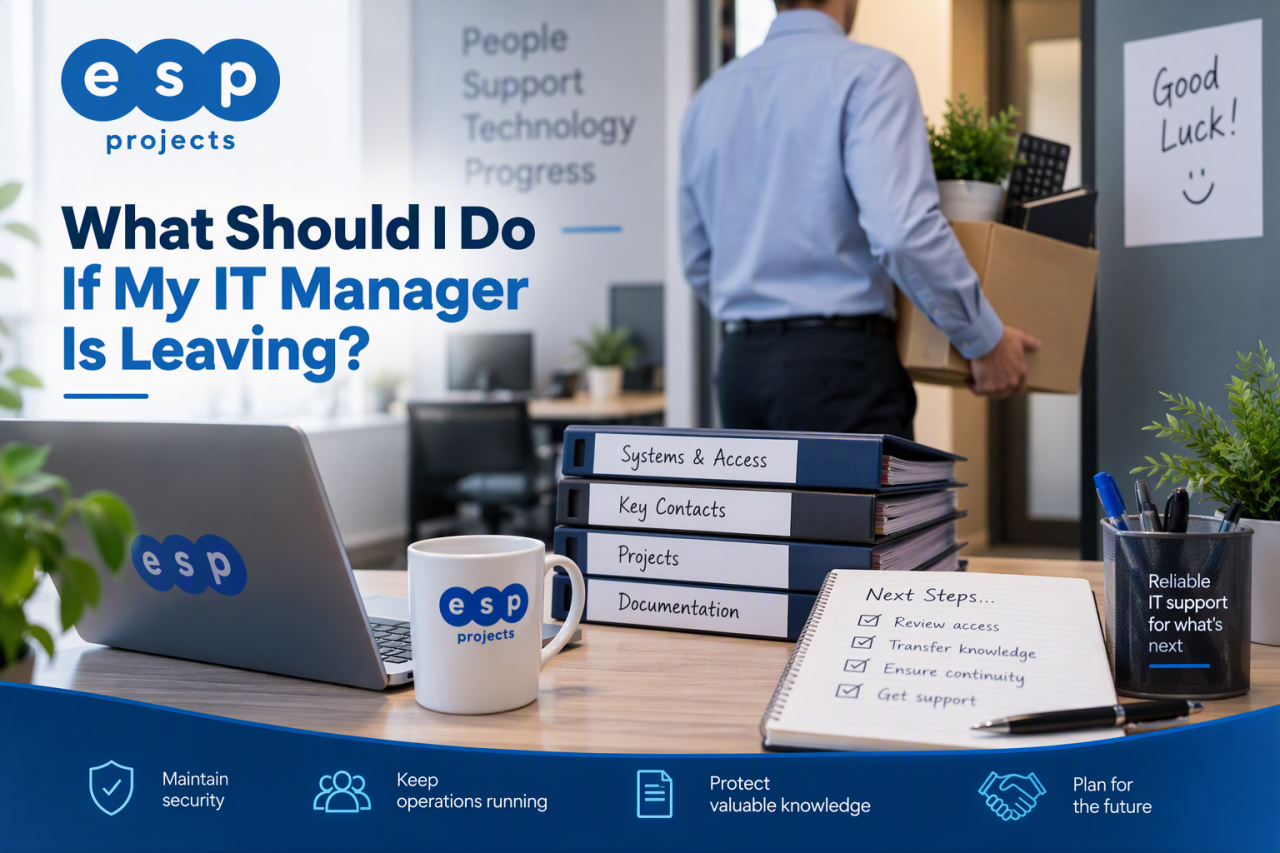
For many growing businesses, the departure of an IT Manager can feel like a major operational risk. The good news is that it does not have to be. With the right planning, support and transition strategy, you can maintain business continuity while deciding what your long-term IT leadership should look like.
Your IT Manager Has Handed in Their Notice. Now What?
If you are running a business with between 40 and 150 employees, particularly in manufacturing, professional services, transport, engineering or distribution, your IT Manager is often the person who holds everything together.
They may know:
- Which systems are business-critical
- Where administrative credentials and passwords are stored
- How the network is configured
- Which suppliers support each service
- What projects are currently in progress
- Which risks are sitting beneath the surface
When they announce they are leaving, it is natural to feel concerned. Questions start moving quickly around the leadership team:
- Who will look after IT now?
- Do we recruit a replacement immediately?
- Can somebody internally take over?
- What happens if something breaks after they have gone?
- How much knowledge will leave with them?
The answer is not always to hire another IT Manager straight away. Some businesses discover that the departure of a key IT person gives them an opportunity to review their entire IT strategy.
Why Losing an IT Manager Can Be Risky
Many medium-sized businesses have an unintended single point of failure. Over time, the IT Manager can become the one person who understands the server infrastructure, cyber security configuration, cloud services, telecommunications, suppliers, disaster recovery plans and business applications.
Even with a cooperative handover, businesses can uncover incomplete documentation, unknown contracts, unsupported systems, unresolved security risks or critical processes that only one person understood. The first priority should therefore be to preserve knowledge before the individual leaves.
Step 1: Capture As Much Knowledge As Possible
As soon as notice is given, begin a structured handover.
System inventory
- Servers and storage
- Network equipment, Wi-Fi and firewalls
- Cloud platforms and Microsoft 365
- Business and manufacturing applications
- Back-up services and critical third-party systems
Passwords, ownership and access
- Administrative accounts and privileged access
- Domain names and DNS
- Back-up platforms
- Supplier portals
- Internet and telephony contracts
- Cyber security tools and licences
Current work and known risks
- Ongoing IT projects
- Planned upgrades
- Security initiatives
- Infrastructure changes
- Outstanding incidents and technical issues
- Renewal dates, warranties and contract commitments
This information is valuable whether you recruit internally, hire externally or engage an IT support partner.
Step 2: Do Not Rush Into Recruiting
One of the biggest mistakes is rushing to recruit a like-for-like replacement before reviewing what the business actually needs.
Before posting the job advert, ask:
- What responsibilities genuinely need to stay in-house?
- Has the role evolved without being formally redesigned?
- Could operational support and specialist work be outsourced?
- Is strategic IT leadership now more important than hands-on support?
- Would one new employee still leave the business dependent on a single person?
The departure may be a useful point to redesign IT around the future needs of the business rather than automatically recreating the past role.
Step 3: Create Immediate Stability
The priority during the transition is business continuity. You need clear accountability for day-to-day support, suppliers, projects, cyber security controls and critical incidents.
This is where an experienced managed service provider can step in quickly, reduce pressure on the leadership team and give the business space to make a considered long-term decision.
How ESP Can Help
ESP Projects can act as your temporary IT department, interim IT Manager or permanent strategic IT partner. We can work alongside the departing IT Manager, take control of operational support and help the business decide what should happen next.
Operational support
- Helpdesk services
- On-site engineering
- Server and network management
- Microsoft 365 administration
- Cyber security monitoring and response
IT leadership
- Supplier and contract management
- Project oversight
- IT budget planning
- Strategic advice
- Board-level reporting
Knowledge transfer
We can work directly with the departing IT Manager to capture systems, access, risks, projects and supplier knowledge before it leaves the business.
A Real Example: Leger Shearings
When Leger Shearings (a tourism company with around 200 staff) needed ESP to take over from its IT Manager in 2025, we completed the takeover in 10 days. That rapid transition gave the business immediate continuity and access to a wider team while it considered the right long-term approach.
The lesson is simple: businesses do not have to choose between recruiting immediately and accepting unnecessary risk. An experienced external IT partner can stabilise the environment, protect continuity and help the leadership team make the right decision rather than the fastest one.
Step 4: Decide What Your Future IT Function Should Look Like
Once the immediate risk has been controlled, assess the longer-term options.
Option 1: Recruit Another IT Manager
This may be appropriate where the organisation needs dedicated internal IT leadership, has sufficient complexity to justify the role and already has technical resources around that person.
Option 2: Use a Hybrid Approach
Some businesses retain an internal IT coordinator or senior leader as the business owner for IT, then use an MSP for technical delivery, projects and specialist expertise. This can improve resilience without losing internal accountability.
Option 3: Fully Outsource IT Management
For many organisations with 40 to 150 employees, managed IT can provide broader skills and greater resilience than relying on one individual. The business gains access to engineers, security specialists, project delivery and strategic advice through a predictable service model.
Do Not Wait Until They Have Left
The strongest transitions begin while the outgoing IT Manager is still available. The sooner knowledge is captured, access is secured and responsibilities are transferred, the lower the operational risk.
Whether you intend to recruit, outsource or explore both options, bringing in experienced support early can protect the business and improve the quality of the decision you make next.
NEED IMMEDIATE IT LEADERSHIP SUPPORT?
ESP Projects can step in quickly, temporarily or permanently, to stabilise your IT operation, by providing both operational support and strategic IT Leadership, even if your existing IT Manager has already left. Over the years, we’ve helped businesses across manufacturing, transport, professional services and engineering sectors maintain continuity during key personnel changes, often taking over in days rather than weeks or months. In the real world, not everything goes according to plan. If that’s where you find yourself, we’re here to help! Feel free to reach out and Book a Consultation