Deciding how to manage your company’s technology is one of the most critical financial choices a business owner will make. You need reliable systems, robust data security, and quick answers when things go wrong. But as your company expands, you must ask: should you build an internal IT team, or should you partner with an external company?
Understanding the true cost of both options goes far beyond simply looking at base salaries. This article breaks down the financial realities of IT support. We will explore hidden costs, compare scalability scenarios for different business sizes, and help you determine which model aligns best with your business objectives.
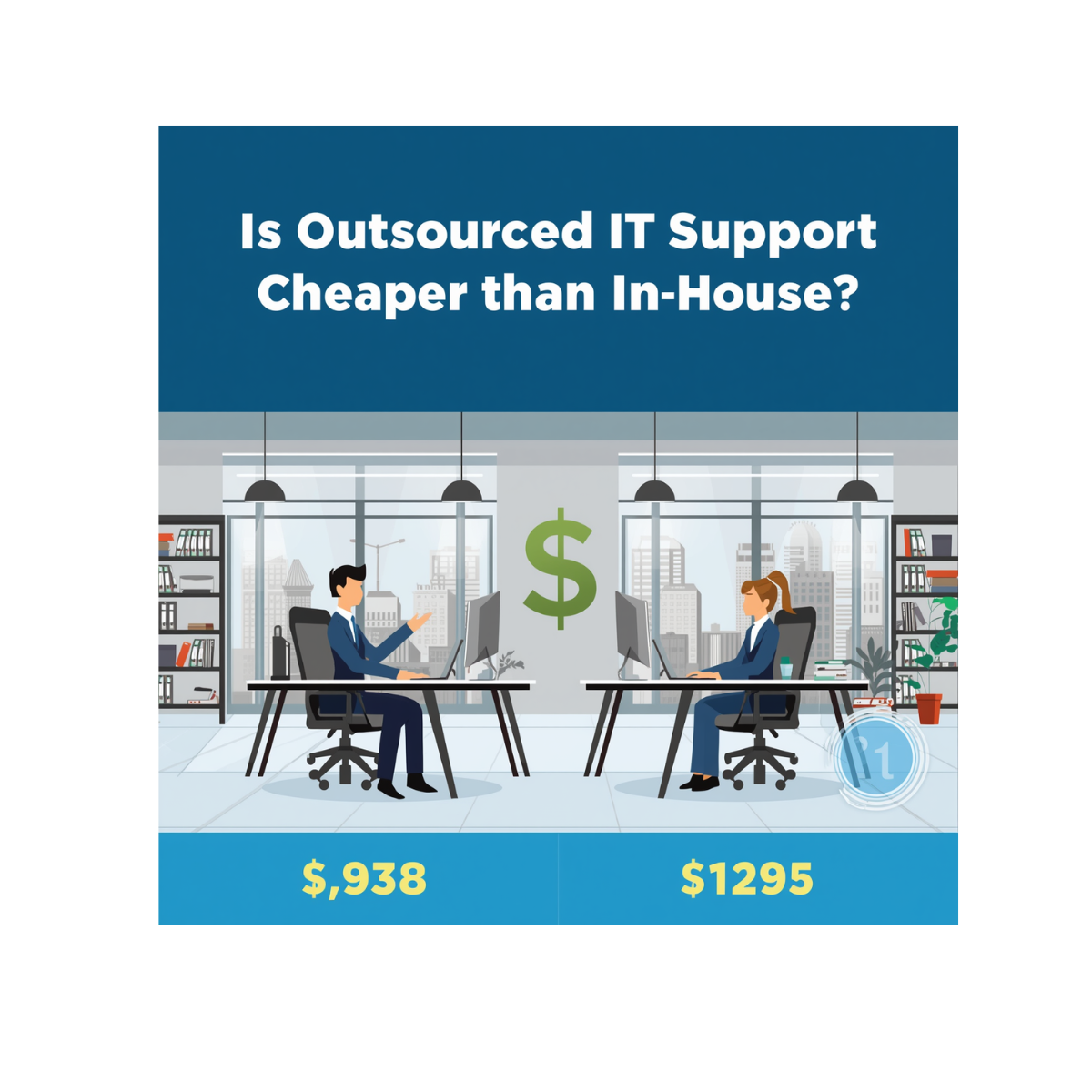
Is Outsourced IT Support Cheaper Than In-House?
Yes. For the vast majority of small and mid-sized organisations, outsourced IT support is significantly cheaper than building an in-house team. For businesses with fewer than 100 users, outsourcing IT is generally 50–75% cheaper than hiring equivalent in-house expertise.
Outsourcing allows businesses to eliminate high salaries, employee benefits, and office space costs for full-time IT employees, replacing them with a predictable monthly fee based on actual usage. If you are still weighing up your options, it is worth understanding what IT support includes and how different service models operate.
Why Compare an Internal IT Team Versus Outsourced IT Support?
Before diving into the numbers, it helps to define exactly what we are comparing.
In-house IT support means you directly hire, train, and manage your own IT staff. These employees sit in your office (or work remotely for you), handle your support tickets, and report directly to your management team.
Outsourced IT support involves hiring a managed service provider (MSP) to handle your technology needs. This external company provides a full team of engineers, helpdesk technicians, and security specialists to monitor and maintain your network remotely. If you want a deeper breakdown, see our guide on managed IT support.
Detailed Cost Comparison: Outsourced IT Support Vs House IT Support
To see the cost efficiency of each model, we must calculate the “fully loaded” cost of an employee compared to a managed service contract.
In-House IT: Fully Loaded Cost Breakdown
When you hire an in-house IT person, you pay much more than just their base salary. Hidden employer costs quickly inflate the total figure.
In-house IT support costs UK businesses between £43,000 and £70,000 per year for a single capable technician when you include:
- Base Salary: £30,000 to £50,000+ depending on experience
- Employer National Insurance & Pension
- Recruitment & Onboarding
- Training & Certifications
- Tools & Software Licences
- Office Space & Equipment
In fact, if you need a team of three to ensure coverage during holidays and out of hours, the total cost of ownership for an in-house IT department can easily exceed £180,000 annually.
Outsourced IT Support Pricing Models
Most managed service providers use a predictable per-user monthly fee. This fee typically covers unlimited remote support, proactive monitoring, patch management, and access to a wide range of security specialists.
Outsourced IT support for a 30-person business typically costs between £16,200 and £28,800 per year. This translates to around £45 to £80 per user per month. This would include both the IT Support Element and the security software required to operate your business, along with some project costs for good measure. Check out our IT Support Pricing calculator page for more accurate information.
Hidden Costs: In-House Vs Outsourced Support
Looking purely at the budget line only tells half the story. Both models carry hidden risks and opportunity costs.
Hidden Costs of In-House IT
The Single Point of Failure:
If you rely on a single in-house IT person, what happens when they go on annual leave or fall ill?
Opportunity Cost of Routine Tasks:
When your highly paid IT manager spends hours fixing minor issues, they are not working on strategic improvements.
Limited Technical Expertise:
A single person cannot be an expert in everything, often leading to expensive external consultants.
Hidden Costs of Outsourced Support
Vendor Lock-In Risk:
Some providers use proprietary tools or restrictive contracts that make switching difficult. If you are concerned about this, it is worth reviewing how to change IT provider safely.
Out of Scope Project Work:
Large infrastructure changes are usually billed separately.
Transition Fees:
Moving providers requires careful onboarding and knowledge transfer.
IT Infrastructure, Service Levels, and Coverage
When you hire in-house, your coverage is generally limited to standard business hours. If a critical system fails outside of those hours, response times can be slow.
Alternatively, outsourced IT support typically offers 24/7 coverage. This reduces the likelihood of downtime and ensures issues are identified and resolved before they impact operations.
Outsourced providers operate under strict Service Level Agreements (SLAs), guaranteeing response times and accountability. If you are comparing providers, our guide on choosing an IT support provider explains what to look for.
Cost Savings Scenarios By Company Size and IT Team
The cost efficiency of outsourcing shifts as your company grows.
Small Business Example (10–30 Users)
Outsourcing provides significantly better value. Hiring a full-time technician is often unnecessary at this stage, and outsourced IT support can reduce costs by 50–65% while delivering enterprise-level capability.
Mid-Size Business Example (50–120 Users)
The break-even point for in-house versus outsourced IT support typically occurs around 75–100 users. At this stage, many businesses adopt a hybrid model.
Large Business Example (250+ Users)
Larger organisations often require small internal teams but still outsource some of their service needs to an external partner.
Company Culture, Control, and Risk Management
An in-house IT team offers direct oversight and cultural alignment.
However, outsourcing can still provide strong control when backed by clear SLAs, regular reporting, and proper documentation. Strong IT security practices and governance are essential regardless of the model you choose. For independent guidance on managing cyber risks in small businesses, the NCSC Small Business Cyber Security Guide provides practical, UK-focused recommendations.
Hybrid Models and Best Practices for Co-Managed IT
You do not always have to choose one or the other. Many businesses adopt a hybrid approach.
In this model, an internal IT manager focuses on strategy and day-to-day user needs, while an outsourced provider handles monitoring, patching, and security.
This approach works best when guided by a clear IT roadmap that aligns technology with business growth.
Decision Checklist: Is Outsourced IT Support Right For You?
If you are currently weighing up your options, use this checklist:
- Analyse your true costs
- Assess your coverage needs
- Identify single points of failure
- Evaluate your security posture
- Consider scalability
Conclusion and Next Steps
Ultimately, while having an internal IT team offers direct oversight and cultural alignment, the financial reality is clear. For most growing UK businesses, outsourced IT support is significantly cheaper, more scalable, and less risky than relying on a small in-house department.
Outsourcing eliminates the hidden costs of recruitment, training, and sick cover, providing immediate access to a full team of experts.
Do not guess when it comes to your technology budget. Contact ESP Projects today to schedule a comprehensive cost-benefit audit. Our team will review your current IT expenditure, identify areas where you can save money, and design a tailored support package that perfectly aligns with your business goals.